














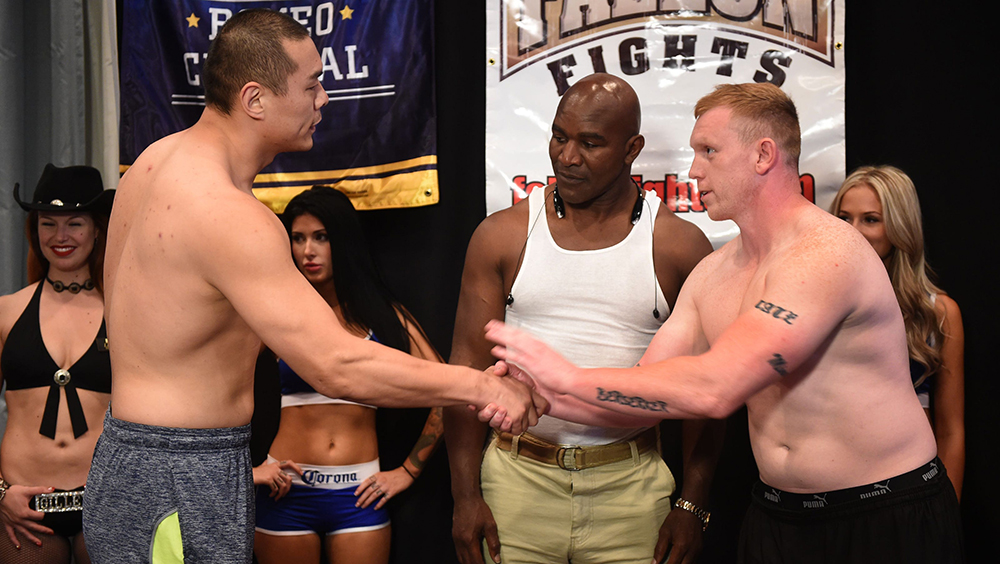
With Leon Spinks recently passing away, a lot of attention has turned towards his win over Muhammad Ali. However, the tail end of his career was far less illustrious with a win over some hump named Eddie Curry among the highlights. That’s Eddie and not Eddy Curry by the way.
Anyway, the record book shows Spinks winning the 1994 fight. However, his win wasn’t really a win at all, according to Charles Farrell who was Spinks’ manager at the time.
“Eddie Curry won a unanimous decision. It was announced in the center of the ring,” Farrell said in an interview with Bill Littlefield of WBUR. “And I caught this typo which advertised the fight as being a 10-round fight. And I said to Eddie Curry’s manager, who was also a commissioner, and also a guy with whom I had done business – ‘business’ in italics – before, ‘Well, we have two more rounds.’ And Eddie Curry refused.”
Instead, one of the lamest examples of a boxing dive took place. Basically, Curry’s manager and Farrell agreed to go back to the locker room and ‘settle’ the result.
“All we need to do is phone it in to the record book as a TKO win for Leon,” Farrell said. “As long as it’s reported as that, that’s what the record will say. And I don’t care what 300 people have seen. It’s not going anywhere. And so we made a deal, and Leon got the win.”
Another form of diving: The bone-breaking history of the world record high dive
What is a boxing dive?
A boxing dive is where one fighter agrees to lose on purpose. Usually, it takes place in the ring during a specified round. The key is making it look as real as possible. That means the winning fighter isn’t in on the fix and fights like he or she would normally. On the other hand, the losing fighter has to make it look competitive while not threatening the opponent.
When did diving start?
While it is hard to pinpoint when the first boxing dive took place, the act is most likely as old as the sport itself. Many people believe Jack Dempsey, one of boxing’s original superstars, took a dive during the early part of his career in the 1910s. However, the moment people started betting on dudes hitting each other, someone was looking to fix the result for profit.
Non-stop losing: The story of the worst team in college basketball
The most famous boxing dive
Jake LaMotta losing to Billy Fox in 1947 remains the most famous example of a high-profile boxer taking a dive. He actually admitted this fact to the US Senate in 1960 during the Kefauver Hearings which were investigating how the mafia managed to infiltrate public institutions.
Unlike most boxing dives, which involved a boxer losing on purpose for money, LaMotta had to pay the mob US$20,000 in addition to losing the fight. The payoff was a shot at the title. It’s a wild story.
https://twitter.com/Gambling_USA/status/1187731704729014272
Calling out divers is problematic
Any competent boxer can take a dive while giving themselves plausible deniability. Even in cases when it seems like an obvious dive, it can be near impossible to confirm. Take Willie Pep for example. Most people think he threw his 1954 fight against Lulu Perez, but the video is inconclusive.
Most cases of boxers taking a dive are like that. Everyone knew that Pep had money and gambling issues going into that fight. Prior to this bout, Pep almost never got punched. Bookies even took the fight off the board at the last minute. However, there was no smoking gun to prove he took a dive. This has been one of boxing’s biggest issues.
Really obvious boxing dives
There are some boxing dives which are so painfully obvious that you don’t need confirmation. Seeing is enough to make you a believer. Take this bout between Zhang Zhilei and Curtis Tate in 2014.
The flop and the phony surprised look on Tate’s face after being knocked down by the shoulder punch are all clear signs the fix was in here.
Another great example of a boxer taking a dive is Mario Cawley in his fight against Hasim Rahman. Cawley has clearly bet on himself to lose by knockout, but also doesn’t want to get hit. You kind of have to admire his audacity here. I mean there are a few times he just throws himself down on the mat.
Sometimes a boxer takes a dive because they don’t want to get their brains beat in. That was the case when Bruce Seldon fought Mike Tyson in 1996. The first knockdown saw Seldon throw himself on the canvas. Then he got knocked down a second time, took a look over at Tyson wanting to murder him and pretended to have wobbly legs. Seldon took a dive here just so he could go home.
Butterfly effect theory time. Had Seldon not taken a dive then and there, maybe Tupac Shakur isn’t shot after the fight that night in Las Vegas. Just saying.