




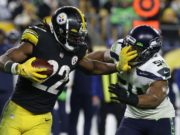














Section 7, Article 3, Item 4, Point 1 of the NFL rulebook continues to come under fire. You most likely know this as the “offense fumbles in the end zone trying to score” rule. It continues to draw scorn from fans and pundits alike who think it is somehow unfair. It’s not, by the way. If anything, the NFL fumble in the end zone rule is perfect.
More Football: The NFL has a huge intentional grounding problem
Here’s why the NFL fumble in the end zone rule is perfect
Why is a touchdown called a touchdown? Well, that dates back to the early days of the sport, when it was basically still rugby and players needed to place the ball on the ground to score. Of course, this evolved over the years, eventually leading to the creation of end zones and the current terminology of ball breaking the plane with possession.
The NFL fumble in the end zone harkens back to those early rugby days of American football. If you try grounding the ball and it’s not fully in place (i.e., it touches the end line or sideline), you lose possession. There are also several other things a team can do to lose possession in this part of the field, but the spirit of the rule is clear.
It is to balance risk versus reward. In other words, attacking or offensive players don’t get carte blanche on making dangerous plays when trying to score. There needs to be a downside.
That brings us back to the NFL fumble in the end zone rule. When American football introduced the forward pass, there was also a need for a contained scoring area. Prior to this, all you needed to do was run over the line with the ball and touch it to the ground. And if you lost the ball forward at any time, it was a turnover. Thus, the end zone was created.
The purpose of the end zone is simple. It’s an area where scoring can quickly and easily be judged. There is no grounding the ball, no competition and nothing for the defense to do once the ball breaks the plane.
This is where we get to the brass tacks. Offensive players already have a considerable advantage when it comes to the endzone. All they need to do is break the plane with possession of the ball. This makes it a different space from anywhere else on the field.
That alone justifies the difference in the fumble rule. It is universally agreed upon that end zones are not the same as the rest of the field. Why should losing a fumble out of bounce here be the same as the other 100 yards? This is constantly cited as a primary reason for the rule change. But it makes no sense. If a player catches a pass at the 40-yard line or gains a first down, play isn’t immediately ruled dead.
More importantly, offensive players know the risks and rewards involved with this part of the field. What is the reward for making a potentially dangerous play with the ball? Six points. The downside? A turnover, regardless of if the other team recovers or it goes out of bounds.
Eliminating the rule gives offensive players more freedom to be reckless with the ball in an attempt to score. Seriously, if you don’t want to lose possession, don’t reach the ball out. Most players wouldn’t try these types of plays anywhere else on the field, but we want to give them a mulligan when close to the end zone.
If you want to change the NFL fumble in the end zone rule, then reinstitute grounding the ball to score as well. If the end zone is live, make it live. Give defenses a chance to make a play.
Make no mistake; I do not want that to happen. I’m a big rugby league guy, but this is not something I want to see in football. It would make the end zone pure chaos. But you have to do something for defenses.
Or, we could keep the rule and offensive players can continue to weigh the risk of a fumble out of the end zone against the reward of a touchdown for stretching the ball out. What’s really so terrible about this as it is? If anything, I’d argue that the NFL fumble in the end zone rule is actually perfect.
Keep Reading: Winning despite mediocre quarterback play is the real Pittsburgh Steelers tradition