









If you don’t like fat guys, this isn’t the article for you. We’re talking about the big boys in the trenches. Offensive lines rarely get the attention they deserve, especially when it comes to fantasy football. But they are the warriors that hold the lines and dictate the tempo of the game.
In terms of fantasy football, it’s hard to quantify the value of a good offensive line. They’re measured on metrics like sacks allowed and adjusted line yards. Today I’ll be tackling (pun intended) this topic with hopes of convincing you to look at offensive lines when making your picks this season.
By the numbers
A quality offensive line and time of possession go hand-in-hand. Seven of the 10 highest-rated offensive lines last year also ranked among the top 10 in time of possession. When you control time of possession, you have more opportunities for targets, yards, and touchdowns. Yards after contact (YAC) was created to evaluate RB productivity. Yards before contact (YBC) provides a glimpse of what the offensive line is doing during a game.
Last year, the New York Jets allowed a league worse 0.7 yards before contact. They also ranked as one of the worst lines in the league. It’s no surprise that the Jets rushed for the second fewest yards per game in2019, a fact not lost on those who drafted Le’Veon Bell
On the flip side, Baltimore had one of the best lines all year. The success of their run game proves that point. Lamar Jackson led the league with 4.9 YBC. Part of that is due to Jackson being the NFL MVP and a rare breed of athlete, but his offensive line did their job in keeping him upright.
The Baltimore Ravens average time of possession in 2019 was 34:24. 🤯That’s 1 minute 35 seconds higher than the next closest team, the Philadelphia Eagles. To put it in perspective the 2-6 teams are separated by 1 minute 29 seconds. Kansas City was #19 at 29:27.
— dadbodfantasyfootball (@dadbodff1) July 8, 2020
Pass Blocking
When looking at QB’s, I don’t want a guy who is always running for his life. QB hurries cause off-balance throws which are less accurate than a QB with his feet set. Unless you’re Patrick Mahomes that is. Drew Brees, Derek Carr, Ryan Tannehill, Kirk Cousins and Jimmy Garappolo led the league in passing completion percentage among quarterbacks with 20 attempts per game in 2019. All five were protected by lines ranked in the top 10 last year.
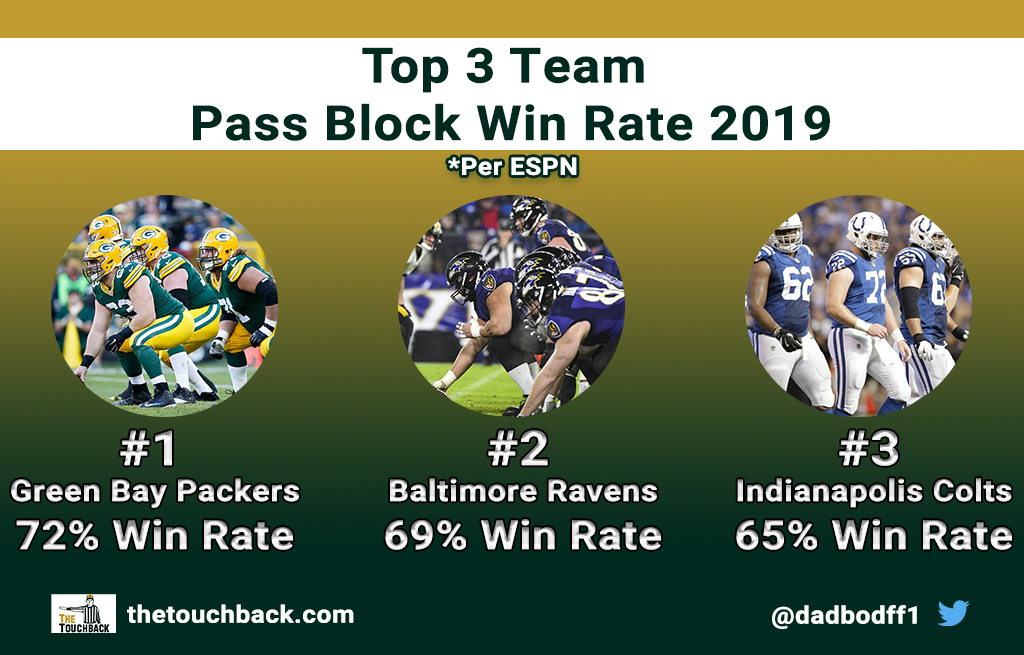
ESPN.com came out with a pass block win rate for lineman who sustain their block for 2.5 seconds or more. To generalize, it ranks which teams are giving their QB more time to find an open receiver. The top five offensive lines from last year were Green Bay, Baltimore, Indianapolis, Tennessee, and Oakland.
Now understand that these numbers are marginal. Kyler Murray’s ADP is in the top five this year and he was the third most sacked QB in the NFL last year. Russell Wilson is almost better at scrambling and making ridiculous throws while being rushed constantly in Seattle. The recent success of mobile QB’s in the NFL validates this.
Final thoughts on offensive lines
You can’t attribute every sack in the NFL to the offensive line, and you can’t take away from the success of elite-level RB’s. If you find yourself stuck between two players with similar ADP’s, I advise you to do some quick research on their offensive lines as the tie breaker. Targets, passing attempts, rushing attempts and opportunities funnel directly from how many possessions the offense has a game. As mentioned earlier, the teams with the best offensive lines statistically have the most opportunities. And as we know, opportunities equal points in this game of unpredictability.