












On June 26, 1995, a Volkswagon Vanagon veered off the road into a pair of trees in Emporia, Virginia. Both driver and passenger were killed immediately. The driver was identified, but law enforcement was unable to determine the identity of the passenger. The only clue they found were two scalped Grateful Dead tickets in his pocket. For the next 20 years, this unknown Dead fan would be known as Grateful Doe.
The mystery was eventually solved, and by that time Grateful Doe had became a sort of mysterious, legendary figure.
In many ways, the NBA career of the man known as “Grateful Red,” and “World’s Tallest Deadhead,” a man who has pocketed scalped Dead tickets many times himself, is as much a statistical mystery.
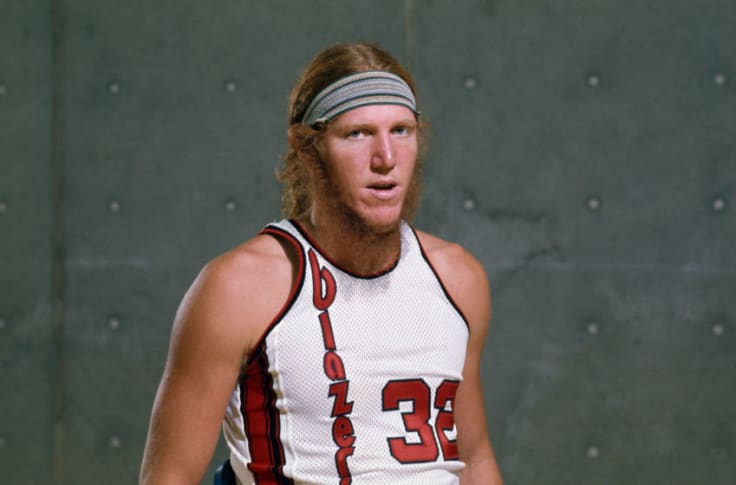
Bill Walton’s entire basketball career is a statistical outlier.
Bill Walton was the best college player of all time
Bill Walton’s early basketball career was really as good as it can possibly get. He was the named the Naismith College Player of the Year three consecutive times from 1972-74 in college, leading UCLA on an 88-game win-streak highlighted by a pair of NCAA championships. The UCLA Bruins went undefeated for two consecutive seasons with Walton in charge. He averaged 21ppg/15rpg/5.5apg. The apex of his college career was on its biggest stage. In the 1973 NCAA title game he shot 21 for 22 from the field for 44 points.
In his three seasons starting for UCLA, Walton went an unbelievable 86-4.
This video of the 1973 NCAA title game is criminally underrated. Walton cannot be stopped. He scores in every way possible. His passing looks Birdesque. His movements are lightning quick. Watch Memphis players’ body language; it doesn’t take an expert in kinesic behavior to see that they already know Walton can’t be stop.
For a second you also see a shaky knee. He looks clairvoyantly fragile a moment later.
Bill Walton in the NBA
Bill Walton joined the NBA as the first overall pick in 1974 and the injuries began immediately. He sprained his ankles constantly. He broke his wrist more than once. He endlessly dislocated fingers and toes. He somehow broke a toe on a water sprinkler and he injured his leg in a Jeep. He missed nearly half of his games in his first three seasons and, although he was still averaging a double-double when on the court, Walton was clearly not playing at full strength.
By 1977 he fully recovered and was again unstoppable. The 6’11” center led a resilient Portland Trailblazer team past Kareem Abdul-Jabbar’s Lakers in the conference finals and past a Julius Erving-led 76ers team in the finals to claim his first NBA championship. He was the Finals MVP. He was an All-Star and All-defensive first team selection. Is there conceivably a way to have a better season than that?
Walton continues his dominance in the NBA
The next year he won his second league MVP. He led Portland to an incredible 50 wins in their first 60 games. In what has to be the most unfortunately timed injury of his career, he broke his foot again which ended his season. Portland went 8-14 in their remaining games without him and lost in the playoffs. Had he stayed healthy for the remaining 22 games, Walton had Portland on pace for a 69-win season, something that has only been accomplished four times in NBA history.
The 1979 season was lost as Walton battled with his front office about incompetent and unethical injury treatments. He sat out that season.
Walton Statistical Anomaly #1
His 18.9 PPG for that season is the third-lowest total to win the MVP award in history. Interestingly, the top two lowest MVP PPG totals both belong to Steve Nash, but that’s a topic for another day.
The Boston Era
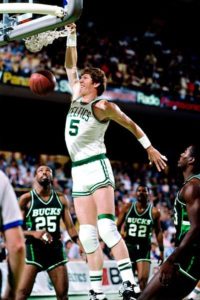
Walton was traded and suffered through a few uneventful and injury-ravaged seasons with the Clippers before ultimately joining Larry Bird, Kevin McHale, Robert Parish and Danny Ainge in Boston for the 1986 season where he won a second championship. He isn’t often mentioned in discussions about the 1986 Celtics championship or the Bird/Celtics Dynasty Era, but that is a little unfair. He was named the 6th Man of the Year in Boston despite playing under 20 minutes/game and averaging only 7.6 PPG.
Walton Statistical Anomaly #2
Once again, Walton is setting records while setting records. Never before has any player won the 6th Man of the Year award while averaging less than than 20 minutes/game. Additionally, only two other times in NBA history has a player received the award with less than than 10 PPG and those are 9 and 9.9 PPG. Walton’s 7.6 PPG is a massive statistical outlier.
The two other players who have won the 6th Man of the Year award while averaging less than 10 PPG were Bobby Jones in ‘82-‘83 with 9 PPG and Anthony Mason in ‘94-‘95.
And that was it
Injuries ended his career after ten games in 1987 season. In his NBA career, he played in only 44 percent of his eligible games.
There are other notable NBA careers that have been derailed by injury. These include Greg Oden, Chris Webber, Grant Hill and Derrick Rose, to name a few. While these are each big losses in their own right, none approaches the heights of Walton. The closest example is probably Grant Hill who had two NCAA championships and was a seven-time NBA All-star, but even he falls two NBA Championships and an MVP award short of Bill Walton.
And herein lies what may be Walton’s tantamount statistical record. Has such a successful basketball career ever been plagued by injuries nearly to the degree that Walton’s was? I don’t think it’s even close.
A fun Bill Walton thought exercise
Let’s remove all his injured games and then combine his college and NBA basketball careers. We get about eight and half seasons of Walton on the court and here’s what he managed:
- 4x MVP (College and Pro)
- 4x Champion
- Almost had one of the best NBA seasons of all time (before injury)
- Played injured through most of his career